
From 15W to 90W: How PoE Standards Evolution Changed Transformer Design
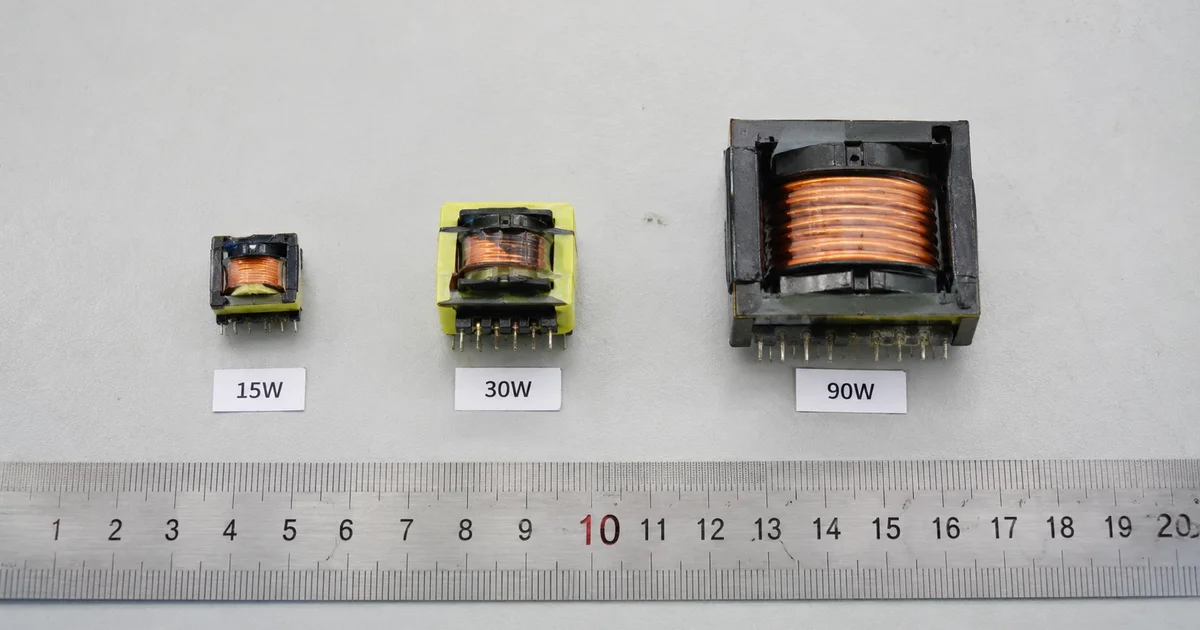
1. Three Generations of Power in Fifteen Years
Power over Ethernet started in 2003 with 15W per port. Today, 802.3bt delivers 90W — six times more, over the same twisted-pair cable, using the same two pairs… or four.
Each step up in power wasn’t just a software change. It forced hardware redesigns, and the transformer — the isolation barrier in every PoE interface — had to be rebuilt each time.
If you’re designing a PoE interface today, understanding how we got from 15W to 90W explains why the transformer on your board looks the way it does, and what constraints drive its size.
2. 802.3af (2003) — The 15W Era
The original PoE standard delivered 15.4W at the PSE (Power Sourcing Equipment), with 13W guaranteed at the PD (Powered Device) after cable loss.
The transformer requirements were simple:
- 1:1 turns ratio for the isolation interface
- Basic isolation (1500Vrms typical)
- Small core — an EP7 or RM6 handled the current easily
- Current per pair: ~350mA
Designers didn’t think about saturation, thermal rise, or creepage. The power density was so low that any reasonable transformer worked. That’s why early PoE transformers were small, cheap, and mostly interchangeable.
The mindset of the era: the transformer was a commodity isolation component. Choose any qualified part, move on.
3. 802.3at (2009) — The 30W Era
PoE+ doubled the power. The PSE now provided 30W, with 25.5W guaranteed at the PD.
Doubling power meant roughly doubling the current through the same two pairs — about 600mA per pair. Suddenly the transformer’s DC resistance and saturation margin mattered:
- DCR became a factor. 600mA through a small winding generated meaningful heat in dense installations (48-port switches).
- Saturation margin tightened. The DC bias from the phantom power current moved the operating point closer to the saturation knee.
- Core size crept up. EP10/RM8-class cores became common for PoE+ interfaces.
This was the first generation where engineers actually read the transformer datasheet’s saturation current row instead of just the turns ratio.
4. 802.3bt (2018) — The 90W Era
PoE++ is a different beast. It introduced Type 3 (60W) and Type 4 (90W) classes, and — critically — four-pair power delivery. Both data pairs AND spare pairs now carry power.
For the transformer, 802.3bt changed four things at once:
1. Two transformers instead of one. With four-pair delivery, you need separate isolation for the data pair transformer and the spare pair transformer. Two components, coordinated design.
2. Current handling up to 1.7A per pair. At 90W over four pairs, each pair carries about 1.7A (with 57V). That’s 5× the 802.3af current. The winding must be physically larger — thicker wire or parallel strands.
3. Saturation margin is now a design spec. The DC bias at 1.7A pushes the core flux significantly. Designers must verify the transformer’s saturation current at the maximum operating temperature, not at room temperature. A core that survives at 25°C can saturate at 85°C ambient.
4. Creepage and clearance tightened. 90W PoE uses higher voltages (50-57V) with larger transient stresses. Outdoor and industrial installations (see 5G small cells) demand 6kV surge immunity, which drives creepage distance up to 6.4mm minimum on the bobbin.
📌 For the outdoor-specific surge and thermal requirements, see our 5G small cell PoE transformer guide.*
5. The Evolution at a Glance
| Parameter | 802.3af | 802.3at | 802.3bt |
| Year | 2003 | 2009 | 2018 |
| Power at PSE | 15.4W | 30W | 90W |
| Power at PD | 13W | 25.5W | 71W |
| Pairs used | 2 | 2 | 4 |
| Current per pair | ~350mA | ~600mA | ~1.7A |
| Transformer count | 1 | 1 | 2 (data + spare) |
| Typical core | EP7 / RM6 | EP10 / RM8 | RM10 / PQ20+ |
| DCR concern | None | Moderate | Critical |
| Saturation check | Never | Sometimes | Always (at temp) |
| Isolation rating | 1500Vrms | 1500Vrms | 1500-6000V (env dependent) |
The pattern is clear: each generation pushed the transformer from “commodity part” toward “engineered component.” By 802.3bt, the transformer selection is a real design decision with thermal, saturation, and isolation trade-offs.
📌 For a step-by-step selection process, see our PoE Transformer Selection Guide.*
6. FAQ — Quick Answers
Q: What does 802.3bt mean for transformer selection?
It requires transformers rated for four-pair power delivery (often two separate components), higher current handling (~1.7A/pair), verified saturation margin at operating temperature, and environment-dependent isolation ratings.
Q: Can I use an 802.3at transformer for 802.3bt?
No. An 802.3at transformer is not designed for 90W four-pair delivery. The current per pair and thermal load exceed its ratings — expect saturation or overheating failures.
Q: How many transformers does an 802.3bt PoE port need?
Typically two: one for the data pairs and one for the spare pairs. Some designs integrate both into a single module, but discrete two-transformer designs are common.
Q: Why did PoE move to four-pair power delivery?
To reach 90W without exceeding the current-carrying capacity of individual twisted pairs (cable heating limits). Spreading power across four pairs keeps current per pair manageable.
Q: Does higher PoE power mean bigger transformers?
Yes. Core size scales with power handling and saturation margin. An 802.3bt interface transformer is typically 2-3× the physical size of an 802.3af part.
Q: What isolation voltage does an 802.3bt transformer need?
1500Vrms is the baseline for indoor use. Outdoor or industrial applications with surge exposure need transformers tested to 6kV surge (ITU-T K.21), which usually means 5000-7500Vdc Hi-Pot capability.
Q: How do I know if a transformer is rated for 802.3bt?
Check the datasheet for: power class (60W/90W), current rating per pair, saturation current at temperature, and isolation test voltage. If these aren’t specified, it’s not designed for 802.3bt.
7. Bottom Line
PoE’s evolution from 15W to 90W transformed the Ethernet transformer from a commodity part into an engineered component.
The requirements multiplied: two transformers per port, higher current density, temperature-verified saturation margins, and environment-dependent isolation. Engineers who treat 802.3bt transformers like 802.3af parts will design failures in from the start.
If you’re designing an 802.3bt PoE interface and want transformers specified for four-pair, high-current operation, send us your requirements — we’ll confirm the right core, winding, and isolation design for your application.

Please Contact Us