The Limits of Switching Frequency in High-Frequency Transformers
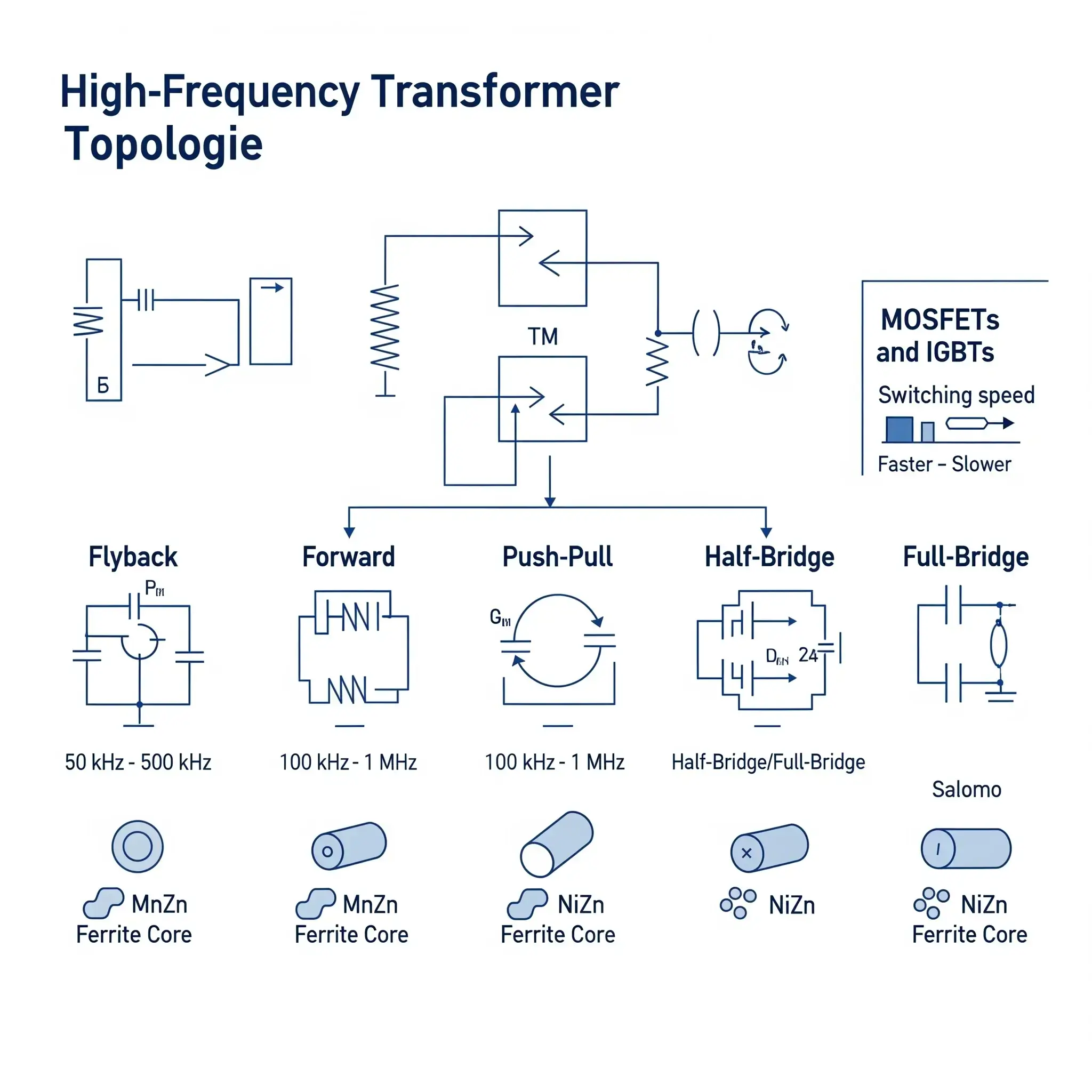
In our previous article, Why High-Frequency Transformers Are Smaller and More Efficient, we discussed how increasing switching frequency reduces transformer size.
But does this mean there is no upper limit to switching frequency, and transformers can be made infinitely small? The answer is no. In practice, the operating frequency of a high-frequency transformer is determined by multiple factors:
1. Circuit Topology
- Flyback
- Typical: 40–100 kHz
- Below 40 kHz: core too large; above 100 kHz: leakage inductance causes voltage spikes that may damage switches.
- Forward
- Typical: 60–150 kHz
- Must balance core loss and switching loss.
- Push-Pull / Half-Bridge / Full-Bridge
- Symmetrical drive magnetizes the core in both directions, enabling hundreds of kHz to MHz operation.
- Requires more complex control and thermal design.
2. Core Material Properties
Core losses include hysteresis and eddy current losses, both of which increase with frequency.
- MnZn ferrite: best for 10–300 kHz
- NiZn ferrite: best for >1 MHz
Higher frequency also requires lowering maximum flux density to avoid saturation. For example, a DMR40 core with 0.38 T saturation is typically limited to ~0.2 T at 100 kHz.
3. Power Device Switching Speed
- MOSFET: very fast (nanosecond switching), theoretical MHz operation, practical limit in hundreds of kHz.
- IGBT: slower turn-off time, typically limited to 40–50 kHz.
4. Efficiency and Thermal Considerations
Higher frequency increases switching and drive losses, lowering efficiency and raising temperature, requiring enhanced cooling.
5. Cost Factors
High-frequency designs require more expensive inductors, capacitors, and thermal management, raising total cost. Budget constraints often define a practical upper limit.
6. Controller IC Limitations
PWM controllers typically have maximum operating frequency ratings to maintain load response capability, further constraining transformer switching frequency.
Conclusion
While higher switching frequency can make high-frequency transformers smaller, limitations from topology, material, power devices, thermal performance, cost, and controller ICs define a practical frequency range.
Designers must balance efficiency, size, and cost instead of blindly pursuing higher frequency.

Please Contact Us